Sunday, October 27, 2019

Reading Old Timetables


I love reading timetables.  Not the new ones on smartphone apps, but the old printed ones.  Reading about a train or plane’s journey on paper is almost like taking the ride itself.

Growing up in Canada I was fascinated with the two major passenger railroads, the quasi-government owned “crown corporation” Canadian National Railroad (CNR) and the private Canadian Pacific Railroad (CPR).  Both ran transcontinental trains from Montreal and Toronto to Vancouver, a journey of 70+ hours… if they were on time.

I wondered why the CPR’s streamliner “The Canadian” left Toronto at 4:15 pm while its CNR competitor “The Super Continental” left at 6 pm.  And why did the CNR’s later-leaving train arrive 4 hours earlier into Vancouver than the CPR’s?   Reading the 31 stop itinerary explained why:  they took much different routes through the Canadian Rockies.  The CPR’s more southerly, scenic route was the highlight of the trip so they timed the journey for daylight hours.

Canada has two official languages, English and French, so it was by reading those timetables I learned that “quotidien” meant daily, “repas” meant meal and “douane” translated as customs, as in crossing an international border.

Fast forward fifty years and I’m still intrigued with old New Haven Railroad timetables, comparing that crack (private) railroad’s speeds with those of present-day Metro-North and Amtrak.  How did the New Haven make it from New Haven to Penn Station in 90 minutes while it today takes Amtrak 109 minutes?

But old timetables contain more than train times.  They also talk about the entire travel experience.

Did it really (in 1955) cost just $7.75 to go from Boston to NY in coach ($14 in a lower berth, $13 in an upper)?  The old timetables also list the trains’ “consists”… what kind of rail cars made up each run: coaches, Pullmans, Parlor-Lounge car (some equipped with two-way radio telephones) and diners.

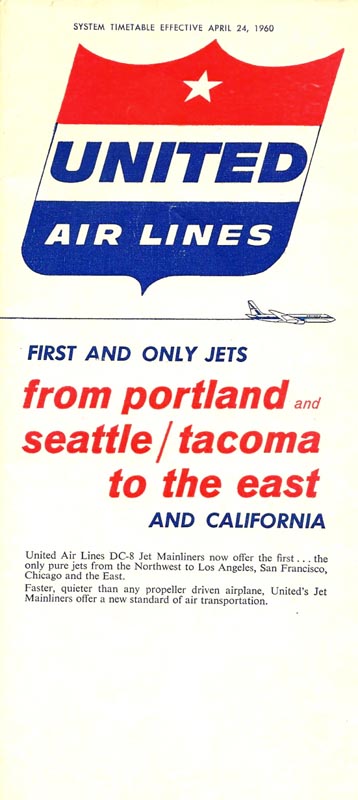
On the aviation side I remember when airlines published their own timetables too, often promoting their advanced aircraft:  American airline’s 707 Astrojet, United’s DC-8 Mainliner and Braniff Airlines “Conquistador” DC-6

The illustrations were always of well-dressed travelers smiling as they boarded their planes using ground-stairs, long before airports had jetways.  The seating looked roomy and comfortable as well-coiffed stewardesses served elaborate meals.

But the grand-daddy of all airline timetables was the OAG, the Official Airlines Guide, a phone-booked-sized (look it up, kids) compendium of every flight in the country.  As a one-time road warrior I even subscribed to the “pocket” version which was about an inch thick.  Miss a flight?  Your OAG would show you the alternatives.

What I enjoyed most reading the OAG’s railroad-style timetable wasn’t the flight times, and later, the on-time performance percentage, but the kind of aircraft used on each flight.  I took a liking to TWA’s iconic L-1011’s and avoided American’s DC-10’s after the deadly 1979 crash at O’Hare.

And after 9/11 I always opted for any airline flying Airbus equipment.  The reason?  The 9/11 terrorists had gone to flight school to learn how to fly traditional “yolk” flight controls, but only the airlines’ own simulators could train pilots on the Airbus fly-by-wire joystick controls:  i.e., Airbus jets were not going to get hijacked.  Or so I hoped.

Today there are no paper timetables.  All the information is online and on my phone… handy, but not as romantic.

Posted with permission of Hearst CT Media


Thursday, October 17, 2019

CT's Own Igor Sikorsky


Have you ever flown in a helicopter?  They seem such a glamorous (if expensive) way to travel, bypassing the traffic enroute to the airport or sightseeing over rugged terrain.

But do you know that the helicopter had its first flight ever right here in Connecticut, the creation of Russian immigrant and inventor Igor Sikorsky, 80 years ago.

Sure, Leonardo da Vinci made early drawings of a vertical flying machine, but that was in the 1480’s.  And kids had been playing with hand-turned, propeller-driven toys for centuries before that.

Sikorsky drew his earliest concept drawings of a helicopter years before the Wright brothers ever flew at Kitty Hawk.  But when he fled Russia with his family, it was fixed-wing aircraft that gave Sikorsky his start in aviation.

At the age of 21 he designed his first airplane, the S-1, a single-engine pusher biplane. Twenty-three designs later he built the S-42 flying boat, made famous by Pan American as “The Flying Clipper”.  The four-engined craft had a range of 1200 miles carrying 37 passengers by day or 14 by night in berths, cruising at 170 mph.

Even as Pan Am was opening literally over-seas markets, Sikorsky was still working on his dreams of a helicopter.  At his plant in Stratford his VS-300 made its first flight, albeit tied to the ground, in September of 1939.

A 1942 version, the Sikorsky R-4, became the first mass-produced helicopter, quickly adopted by the armed forces of the US and UK. It had only one crew member, could only carry 500 pounds, but had a range of 130 miles flying 65 mph at up to 8000 feet.

Flash forward to the present and Sikorsky’s old company, now part of Lockheed Martin, still produces helicopters. Sikorsky’s successor companies, then part of United Aircraft Corp, even designed the short-lived (1968 -1976) Turbotrain, powered by a Pratt & Whitney turbine “jet engine”.  The train could make the 230 mile New York to Boston run in three hours and 39 minutes.  Today’s Acela can do the same run in no less than 3 hours 55 minutes.

In a competition with the electric-powered Metroliner in 1967, the Turbotrain hit 170 mph, a land speed record for a gas turbine-powered rail vehicle. Acela does no better than 145 mph.

Today’s modern helicopters come in all sizes and speeds… from the beefy Seahawk SH-3 “Sea King” which can carry five tons over 600 miles at 166 mph… to “personal” helicopters for one person flying 60 miles at 80 mph.

For helicopter fans, New York’s east-side heliports at Wall Street and 34th Street offer the chance to see luxury craft in action, some privately owned, others offering passenger service.  BLADE Helicopters will get you to the Hamptons from midtown in 33 minutes starting at $695 one-way.  

In the 1960’s NY Helicopter flew from the NY airports to the top of the Pan Am building. I took that flight once, transferred to an elevator and walked onto a train in Grand Central.  For awhile they even choppered to Stamford’s heliport on Canal Street in the South End.

Much has changed in aviation in the last 80 years since Sikorsky’s first helicopter took to the air.  And to think that it all started here in Connecticut.

Posted with permission of Hearst CT Media


Thursday, October 10, 2019

Amtrak's Next Acela


I’m a big fan of high speed trains, which means I often ride Amtrak’s Acela to Boston or Washington.  It’s the best train in North America, though it pales in comparison to true HSR (high speed rail) in Europe or Asia.

While Acela can hit a top speed of 150 mph, it does so on only 34 of the 457 miles between DC and Boston.  Over the entire run, what with congestion and station stops, it only averages about 70 mph.

But its 20 runs a day are highly popular, especially with business travelers on expense accounts (the fares are roughly double usual coach fares).  The trains are often sold out and, depending on whose accounting you trust, actually make a profit for the quasi-public corporation, carrying 3.4 million passengers a year:  25% of Amtrak’s total revenue.

As well maintained as the Acela fleet is, it’s getting old.  The trains have been running almost 20 years old and they’re too small, carrying just 304 passengers per trip.  Compare that to the Eurostar from London to Paris (750 passengers per train) or Japan’s Shinkansen from Tokyo to Osaka (1300 passengers).

So, Amtrak is building the next generation of Acela.

When it was shopping for the first Acela, Amtrak tested two European designs… the Swedish X2000 tilt-train and the German ICE Train.  Liking elements of both, they opted for neither, instead going for a brand new design custom built by Bombardier and Alstom.  This time they’re going with a proven design modeled after Alstom’s French TGV and Italy’s Pendolino.

The new Acelas will carry 378 passengers and will be built with aluminum bodies.  They’ll be capable of speeds of 220 mph but will probably never achieve those rates.  Given the old roadbed and signal system, they’ll probably max out at 160 mph on the small portion of track that can handle it.  Think of a Ferrari trying to drive on a potholed I-95.

So while they’ll be no faster than the existing Acelas, they may be more comfortable. Using an active tilting system they’ll be able to go faster through the Northeast’s many curves, without tossing passengers or their drinks into the aisle.

Each of the 28 trainsets will have engines at each end pulling and pushing nine passenger cars.  If ridership remains strong, three additional articulated coaches can be added to each trainset.

The seating will be Business and First Class (Coach is only for the slower and cheaper Northeast Corridor trains).  Each plush leather seating row will have power and USB plugs.  The Café Car will be snazzier, too.

The initial trainsets are being built now at Alstom’s plant in Hormel NY.  Testing should start this fall at the FRA’s test track in Pueblo CO and, if all goes well, on the Northeast Corridor itself by December.

Assuming no problems, the new Acelas should enter commercial service in 2021 with all 28 sets delivered by 2022, at which point Amtrak will retire the original models.

Mind you, these new cars are not cheap:  about $2 billion for the 28 trains, making them Amtrak’s most expensive purchase ever.  Each train will cost about double what its European counterparts do because of FRA requirements for crash-worthiness:  the engines are built like a tank to sustain any impact in a crash.

So hang in there rail fans.  Something new is coming from Amtrak to a train line near you!

Posted with permission of Hearst CT Media.

Friday, October 4, 2019

Commuting Can Make You Sick

It shouldn’t come as much surprise to learn that commuting, especially by car, is hazardous to your health.

Research now shows that the longer your drive, the greater the risk of obesity, heart attacks and even low birth-weight babies for moms-to-be.  At fault are a number of factors:

STRESS:      Being stuck in bumper-to-bumper traffic increases your cortisol and adrenaline levels, increasing your risk of a heart attack during your drive and for an hour after. Getting angry when someone cuts you off only makes things worse.  Increased blood pressure also leads to lack of sleep, leaving you tired even as you leave the house each morning.

OBESITY:     The longer your commute, by car or mass transit, the more sedentary your life and the less exercise you get.  Couple that commute with fast food (and its sugar, salt and fat) and you’re at even greater risk.

BACK & NECK PAIN:        A 2010 Gallup poll shows that a third of all people who commute more than 90 minutes a day complain of pain due to poor posture and uncomfortable seating.

POLLUTION:     The longer you’re stuck in traffic the more bad air you breathe. A 2007 study of Los Angeles residents showed that half of their exposure to harmful air happened during their drive time.

LOW BIRTH-WEIGHT:      Researchers at Lehigh University, studied New Jersey birth records. They found that for pregnant women commuting 50 miles each day, there was a 1% increase in the chance of having a low birth-weight baby for every ten miles they traveled. Not only was “chronic maternal stress” a factor, but so too were missed doctor visits due to lack of free time.

The average commute time for Connecticut residents is 26 minutes each way, and climbing.  For Fairfield County residents going to jobs in New York City, it’s more than an hour.  And as traffic worsens and trains run slower, those commute times are climbing.

For those who bike or walk to work, the risks are lessened, but not eliminated.  The physical exertion is better for your heart, but bikers and pedestrians are still prone to collisions and accidents en route.

Just 20 years ago up to 70% of kids walked to school.  Now it’s only about 20% as the others take the school bus or are driven by Mom.  We’re turning our kids into local commuters at a very young age.

What can you do if you must commute long distances?  Plenty:

Try not to get stressed out while driving.  Leave a bit earlier than usual so you’re not grinding your teeth fearing you’ll be late.  Listen to books on tape, podcasts or something fun… not the news, which will only contributes to anxiety.  Try varying your route.  A change of scenery will keep you engaged.

On mass transit, don’t isolate yourself.  Socialize by talking to your fellow commuters (but not in The Quiet Car!)

In your automobile, keep the windows up and the air recirculating to avoid auto exhausts.  Make up for the sedentary (though stressful) drive by taking a walk at lunch.

Acknowledge the lack of control in your commute when traffic or train delays happen.  Just know that you’re doing the best you can with the things you can control… that you’re going to get there eventually and most of all that you’re trying to get their safely.

Posted with permission of Hearst CT Media

Friday, September 27, 2019

U-Pass Helps Train CT College Students


Imagine having an unlimited-rides pass on all public transit in Connecticut, including Metro-North.  Then imagine this pass only cost you $20 a year.

Such is the reality of U-Pass, the transit pass given to almost 15,000 community college and state university students in our state.  Not only does U-Pass give them affordable access to mass transit, in some cases the pass is a life changer.

“If I didn’t have U-Pass I wouldn’t be able to go to school,” says 21 year old part-time student Sabrina from Stratford.  Sabrina relies on her U-Pass to get her to classes at Norwalk Community College where she’s studying early childhood education.

The daughter of a single mom who doesn’t own a car (and also relies on the bus), Sabrina takes a bus, a train and another bus for her 90 minute one-way commute.  She also uses the pass to run personal errands like doctor’s appointments, which is fine with the CDOT and transit operators who devised the U-Pass.

Some students use their U-Pass on the CTFastrak busway system, journeying from campus to downtown to party.  Better they be on a bus than on the highway if they’ve had a couple of beers, no?

Created in 2017 as a brainchild of then CDOT Commissioner Jim Redeker, U-Pass costs every student at enrolled schools $20 a year, whether they use the pass or not, though 26% of all students do.  Many are first-generation college students coming from homes like Sabrina’s, which rely on public transportation.

U-Pass sales bring CDOT and the transit operators $800,000 a year, far less than the individual rides would cost a la carte.

“U-Pass is a great way of introducing public transportation to the next generation,” says CDOT’s Lisa Rivers.  And the response has been phenomenal, enjoying a 47% increase in usage in its second year of operation.

Students just flash their U-Pass and college ID, and they’re on their way.  This fall the U-Pass is being redesigned to show the student’s name and school, making the check of that student ID even easier.

U-Pass is honored not only on the bus but the trains, including Metro-North, but only within the state.  “If you travel beyond Greenwich to New York City, you pay the local fare,” says Rivers.

Students can also use U-Pass on Shore Line East from New Haven to New London and on the new CTrail Hartford Line trains from New Haven to Hartford.  That’s how 20 year old Daniel Pinto from UConn got to his summer job in New Haven where he was applying his civil engineering studies toward a career.  (PS:  He says he plans to keep living in Connecticut.)

But the Hartford Line trains, jointly operated by CDOT and Amtrak, have been having problems with U-Pass riders.  Though both CDOT and Amtrak tickets can be used on either Amtrak or CTRail trains, Amtrak has been refusing service to U-Pass holders on busy afternoon trains due to a lack of seats.  In some cases, U-Pass holders have been kicked off the train so their seats could go to Amtrak riders with reservations.

That’s not supposed to happen and it really speaks to how little Amtrak cares about this line or the service they provide.  Their trains have fewer cars than the CTrail trains, the conductors aren’t properly trained and when CDOT complains, Amtrak basically doesn’t listen.

Some have suggested that the U-Pass program be extended to state workers, though Rivers points out that, unlike struggling college students who must often choose between eating and going to school, the state employees get a paycheck… and free parking.

Posted with permission of Hearst CT Media


Monday, September 16, 2019

Some Ideas for Governor Lamont on Fixing Transportation

How’s your commute going?  Traffic getting worse?  Trains still running late?  As we all get back to work after the summer, commuters’ frustration level is rising as it seems nothing is being done to fix transportation.

Lawmakers in Hartford couldn’t be persuaded to meet to debate tolling this summer, knowing full well the votes weren’t there, so they just kicked back.  But it seems that some on the Governor’s staff were busy this summer trying to “reboot” his transportation plans.  It’s to be billed as “CT 2030”.

May I be so bold as to offer a few suggestions to the Governor’s team?

BE HONEST WITH US:     Admit that Governor Lamont created this transportation crisis by reneging on a legislative plan to put $170 million in auto taxes into the Special Transportation Fund.  By law, that didn’t violate the STF Lock Box rule but it sure did so in spirit.  Lamont should admit that was a mistake.

We also need a full accounting of CDOT spending and waste.  And an explanation of why CT does so poorly on national rankings when it comes to the cost of maintaining our roads.  Scandals like the CT Port Authority & Lottery don’t instill a lot of confidence for taxpayers.

PRIORITIZE:          Rather than beating the dead horse of tolls, let’s do an accounting of what needs to be fixed.  When Governor Malloy rolled out his $100 billion, 30-year “Let’s Go CT” scheme he refused to prioritize.  “We need to do it all, now,” he would say.  So naïve.
Surely the CDOT has a list of what needs fixing first.  Let’s see it.

SAFETY FIRST:      Whether roads or rails, safety must be the top priority.  Who can argue with the need to replace a rusting bridge, corroding catenary or enforcing speed limits?  Safety isn’t shiny or sexy.  It just saves lives, even if it’s often invisible to commuters.
Stop dangling unachievable goals like “30-30-30” or one lawmaker’s fascination with Hyperloop in front of us to distract us.  Just focus on state of good repair. Get the trains running on time, the interstate truck inspection stations open, the speed limits enforced and prevent the bridges from collapsing.

THEN WE CAN TALK ABOUT MONEY:           Once we all understand what needs to be done, with a list of priorities based on urgency and safety, then we can discuss funding.  Tolls are just one option.  If you’re not a fan, fine… but you’re not going to like the alternatives:  sales / income / gas taxes, fees, fare hikes or service cuts.  There’s no “free lunch”, folks.  Decades of delayed repairs will require billions of dollars and we’re all going to pay.

STOP THE “NO TOLLS” BULLIES:        The anti-toll forces, both grassroots and lawmakers, have seemingly pounded a stake through the heart of user-fee options to pay for transportation.  They’re tapped into the rich vein of Nutmeggers’ cynicism and distrust of Hartford.  But now they’re going a step further, threatening anyone running for public office with an organized campaign of opposition if they support tolling… “Vote for tolls. Lose at the polls.”

I can see promising a State lawmaker a hard time if they vote for tolls, but implying similar threats in local municipal races seems unfair.  Why should a First Selectman or Board of Reps candidate, who doesn’t even have a vote on tolling, be held to these bullies’ litmus test for loyalty?

Posted with permission of Hearst CT Media


Commuting In The Good Ol' Days


Commuting is nothing new to Nutmeggers. But to appreciate our current challenges in “getting there”, consider what it was like centuries ago.

As early as 1699 roads had been laid out on routes still used today.  But where today those roads are now lined with trees, in the mid-1700’s those trees were gone as most of southern Fairfield county had been cleared to allow for farming. 

In the 1770’s the maintenance of Country Road (now known as The Boston Post Road) was the responsibility of the locals.  Every able bodied man and beast could be drafted for two days each year to keep the roads in good shape.  But traffic then consisted mostly of farm carts, horses and pedestrians. 
At the end of the 18th century it was clear that Connecticut needed more roads and the state authorized more than a hundred privately-funded toll roads to be built. Yes, friends… toll roads are part of our DNA.
 The deal was that, after building the road and charging tolls, once investors had recouped their costs plus 12% annual interest, the roads were revert to state control.  Of the 121 toll-road franchises authorized by the legislature, not one met that goal.
One of the first such toll roads was the original Connecticut Turnpike, now Route 1,  the Boston Post Road.  Another was the Norwalk to Danbury ‘pike, now Route 7.
On the Post Road four toll gates were erected:  Greenwich, Stamford, the Saugatuck River Bridge and Fairfield.  No tolls were collected for those going to church, militia muster or farmers going to the mills.  Everyone else paid 15 cents at each toll barrier, about $4 in today’s money!
The locals quickly found roads to bypass the tolls which were nicknamed “shun-pikes”.  Sound familiar?
Regular horse-drawn coaches carried passengers from Boston to NY.  And three days a week there was a coach from coastal towns to Stamford, connecting to a steamboat to New York.
The last tolls were collected in 1854, shortly after the New York & New Haven Railroad started service.  An early timetable showed three trains a day from Stamford to NYC, each averaging two hours and ten minutes.  Today Metro-North makes the run in just under an hour.
The one way fare was 70 cents vs. today’s $15.25 at rush hour.
In the 1890’s the one-track railroad was replaced with four tracks, above grade, thereby eliminating street crossings.
In the 1890’s the trolleys arrived.  The Stamford Street Railroad ran up the Post Road connecting with the Norwalk Tramway; the latter also offered open-air excursion cars to the Roton Point amusement park in the summer.
Riders could catch a trolley every 40 minutes for a nickel a ride.  There were so many trolley lines in the state that it was said you could go all the way from New York to Boston, connecting from line to line, for just five cents apiece.
The trolleys were replaced by buses in 1933.
Fast forward to the present where we are still debating tolls on our roads, possible trolley service in Stamford and T.O.D. (“transit oriented development”) is all the rage.  Have things really changed that much over two hundred years?

Posted with permission of Hearst CT Media